
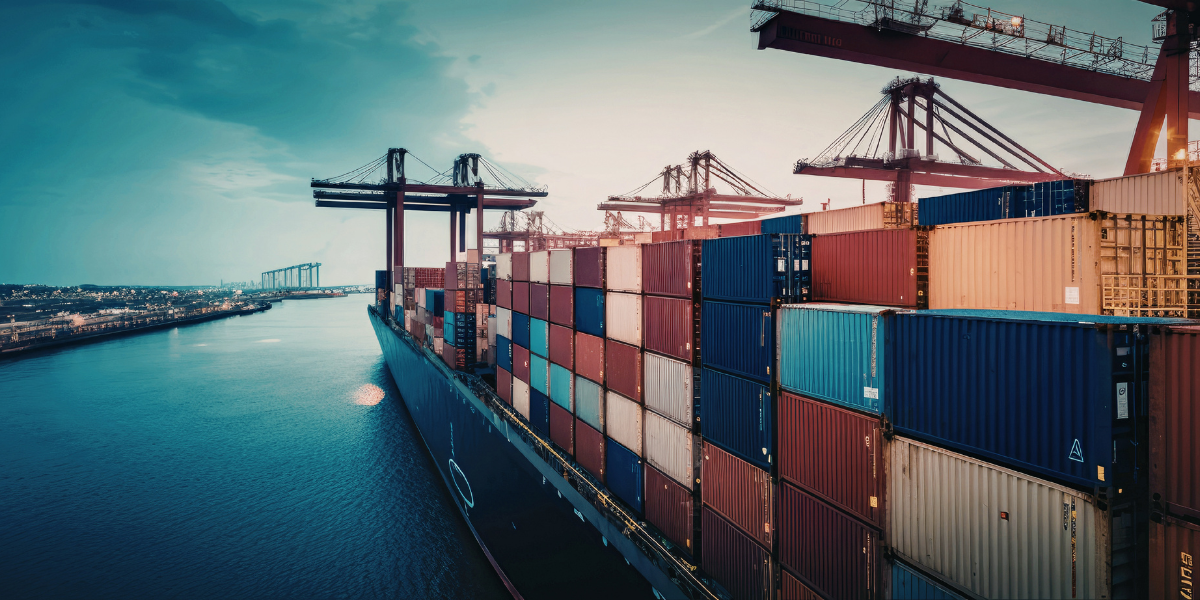
Ports are usually seen as civilian infrastructure operating in relatively predictable conditions. Few in the global maritime industry had seriously considered how commercial ports might function during a full-scale war.
Over the past four years, however, Ukrainian ports have had to operate in precisely these conditions.
Even before the invasion began in February 2022, navigational warnings declared the north-western part of the Black Sea unsafe for navigation.
In practice, this meant that vessels could no longer safely enter or leave Ukrainian ports. Access to ports was effectively closed, and maritime trade stopped almost overnight.
When the full-scale invasion began on 24 February, the situation escalated dramatically. Ports were hit by missile strikes, sea approaches were mined and airspace was closed.
Enemy naval vessels were visible offshore, and the threat of an amphibious landing was real.
From the first hours of the war, ports became high-risk strategic zones operating under close coordination with the armed forces, the navy and border authorities.
For port managers, the most immediate lesson was clear: in wartime, coordination between civilian infrastructure and security authorities becomes the key condition for keeping ports operational.
For roughly six months, Ukrainian ports could not operate in normal maritime mode. Around 130 vessels remained trapped inside the ports, many under foreign flags with multinational crews on board.
Port authorities had to organise the evacuation of foreign seafarers by land while ensuring that vessels remained safely maintained.
At the same time, large volumes of cargo were blocked in port terminals.
Particular attention had to be given to hazardous cargo such as fuel products, flammable materials and chemical cargo. Their concentration during missile and drone attacks created serious additional risks. In many cases, ports prioritised removing dangerous cargo from port areas or redirecting cargo flows by rail and road.
For several months, ports effectively operated as inland logistics hubs rather than maritime gateways.
A number of protection measures were introduced. Floating protective booms were installed in approach channels.
Infrastructure was reinforced with barriers, gabions and concrete protection structures.
For personnel safety, both permanent and mobile shelters were installed directly on berths. Back-up power solutions and rapid repair teams were also organised to restore operations after attacks.
Another critical decision concerned the workforce. During the blockade, ports had almost no operating revenue — there were no vessel calls, no port dues and no cargo-handling income. Yet the decision was made to retain personnel rather than dismiss them.
Losing skilled port workers would have destroyed operational capacity. When maritime operations eventually resumed, ports were able to restart quickly because experienced teams were still in place.
Maritime exports partially resumed under the Black Sea Grain Initiative, which allowed nearly 33m tonnes of cargo to be exported during the year of its operation despite numerous operational difficulties.
When Russia withdrew from the agreement, Ukraine established its own maritime corridor in order to maintain exports under continued security threats.
This corridor operates under strict security-controlled navigation rules. Vessels cannot wait at anchorage near ports because they would become easy targets. Instead, they remain further offshore and approach only within specific time windows.
A vessel may enter port only if cargo is already positioned, a berth is available, loading can begin immediately and security conditions are confirmed.
During approach and departure, vessels are accompanied by search-and-rescue boats to enhance crew safety.
Since September 2023, the ports of Greater Odesa have handled more than 177m tonnes of cargo through this corridor, including over 105m tonnes of grain, with more than 7,000 vessel calls.
Even with these mechanisms in place, operations remain extremely complex. During air-raid alerts, cargo operations stop immediately and workers and crews move to shelters.
Energy infrastructure has also been repeatedly targeted, causing regional power outages that require constant operational adaptation.
Since the start of the war, more than 700 port infrastructure facilities and over 150 civilian vessels have been damaged.
Today, the global maritime industry is again facing rising security risks in different regions, including attacks on commercial shipping and threats to navigation routes in the Gulf.
Many of the challenges now being discussed internationally — damaged vessels, disrupted shipping lanes, blocked navigation and risks to port infrastructure — are realities that Ukrainian ports have been managing for the past four years.
Operating under these conditions has required continuous adaptation and practical decision-making daily.
In many respects, Ukrainian ports have had to develop solutions in real time simply because there were no existing playbooks for managing commercial ports during a full-scale war.
Unfortunately, this experience has been learned the hard way. But if these lessons can help ports in other regions strengthen their resilience and preparedness, Ukrainian ports are ready to share what we have learned.
Dmytro Barinov is the president of the Ukrainian Ports Association.
Source: Ports under fire: What the world can learn from Ukraine
